8 min read
Transparent supply chain evidence before contract signing
A transparent supply chain starts with five verifiable records covering component origin, fixed specifications, shipment routes, substitutions, and spare parts.
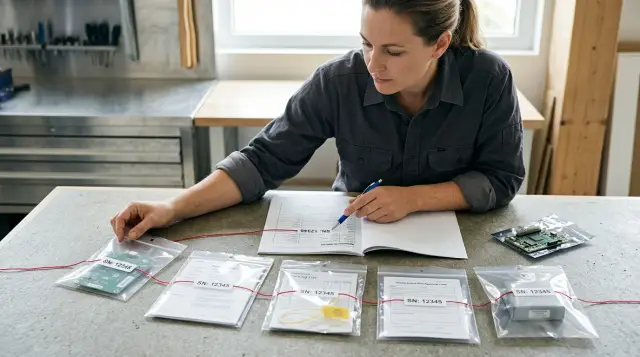
A claim that a supply is transparent proves nothing. Before signing a contract, a buyer needs five connected sets of data: component origin, a fixed specification, the route of the actual shipment, component substitution rules, and a plan for service spare availability. Each set needs an owner, a format, a delivery deadline, and a contractual consequence for discrepancies.
I have seen procurements where the supplier showed a company certificate, a polished configuration table, and a letter from a distributor. During acceptance, the certificate turned out not to cover the shipment, the table allowed several drives under one line item, and the letter confirmed a business relationship but not the path of the goods. The papers were genuine. There was no evidence for that particular supply.
The review is not an exercise in building a thick file. It must link a contract line to a physical device, its serial number, and an event along its route. If that link cannot be reconstructed without a sales manager's verbal explanation, the supply chain remains opaque.
The five records belong in the contract
You need five verifiable chains that converge on one shipment, not five unrelated certificates. Request them before the final contract text is selected, because a supplier has little incentive to disclose awkward constraints after an advance payment.
- A provenance bill links every critical specification line to the manufacturer, exact part number, country of manufacture, and supply basis.
- A configuration baseline fixes the permitted models, revisions, firmware, and measurable characteristics without phrases such as "or equivalent."
- A route log connects the order, packages, serial numbers, warehouses, carriers, and acceptance through dated documents.
- A substitution matrix defines what may change, who approves the change, what evidence of equivalence is required, and when the buyer may reject it.
- A service component plan lists spare parts, their source, availability period, storage location, and delivery process after a failure.
Check four properties for every record. It applies to the named model and shipment, not merely to the supplier in general. It was issued by the participant responsible for the stated facts. The buyer can compare it with a marking or another independent record. An update leaves a history, so yesterday's version cannot be silently replaced.
Create an evidence register at once. It only needs columns for the object being checked, the document or record, the issuer, delivery time, verification method, and consequence of a mismatch. This table works better than a general questionnaire with a hundred questions because it forces the parties to agree on how each claim can be tested.
Define an acceptance test for each item. Provenance evidence may be accepted, for example, when the committee selects a serial number from the supply, finds a critical component's part number in the factory report, and links it to an upstream document. The test should not depend on reaching an employee who "knows where to look." The supplier must provide instructions, a directory structure, and the record owner's contact.
Agree on retention time in advance. If a configuration dispute appears two years later, a link to a temporary file exchange is useless. The contract should state how long reports remain available, the export format when the relationship ends, and the method used to check archive integrity. Third-party documents may have restricted access, but the buyer should retain at least the verification record, document identifier, date, and committee conclusion.
NIST SP 800-161 Rev. 1 describes supply chain risk in terms of poor visibility into how technology was developed, integrated, and deployed. That is a practical contractual guide: visibility exists when provenance and change data can be linked to the system being acquired. A supplier declaration alone does not create that link.
Component origin requires a chain of records
One certificate cannot prove origin because a certificate only answers the question within its stated scope. A document confirming manufacturer status, a management system certificate, and a delivery note perform different jobs. None of them alone shows which processor, drive, or power supply is installed in a particular serialized device.
Start with a bill of materials for the supply. For critical components, request the manufacturer's name, exact part number, hardware revision if applicable, country of manufacture, immediate upstream supplier, and supporting transaction document. Critical items usually include the motherboard, processor, memory, storage, network adapter, power supply, controllers, and components on which stated compatibility depends. The list follows the risk: it will differ for workplace computers and for a server node expected to run for many years.
The word "brand" in this bill provides almost no value. One brand sells multiple lines with different controllers and endurance, while a trade name may stay unchanged after an internal revision changes. You need a part number that appears in the documents and can be checked on the product, packaging, firmware, or a diagnostic export. If it cannot be seen without breaking a warranty seal, agree on another method: a factory report, a photo taken before assembly, or a selective inspection protocol at the production site.
Then connect the levels. A line in the bill must lead to an invoice, delivery note, certificate of origin, declaration of conformity, or manufacturer letter, depending on the claim being tested. Redact commercial prices if the supplier reasonably treats them as confidential, but reject a document that conceals the part number, quantity, date, and transaction parties. After that kind of redaction, the record no longer supports the shipment.
Ask separately what the supplier means by country of origin. The brand's registration location, the component's country of manufacture, the system assembly site, and the final product's legal status may all differ. Kazakhstan's Rules for Maintaining the Register of Kazakhstani Commodity Producers, approved in 2025, link Kazakhstani origin to production in Kazakhstan or completion of a prescribed threshold of processing operations. That is a legal status for the product, not a list of the origins of every installed part. Confusing the two is risky: the buyer receives an answer about local production and mistakenly believes it has reviewed the whole component chain.
Specification stability starts with a baseline
A stable specification means the supplier cannot change a significant part while preserving only headline numbers. A line saying "1 TB SSD" leaves the interface, memory type, write endurance, controller, firmware, and power-loss behavior undefined. Two drives with the same capacity may behave differently in an array, during firmware updates, and after several years of operation.
Fix a configuration baseline in a contract annex. For every item, state the manufacturer, model, part number, minimum revision, firmware version where it matters, and the characteristics used at acceptance. List allowed deviations alongside them. A blank cell means no deviation was approved, not that the supplier is free to choose an alternative.
Distinguish functional equivalence from configuration identity. The first asks whether a substitute will perform the stated function today. The second asks whether the shipment will retain common drivers, deployment images, spares, failure measurements, and support procedures. For a fleet of hundreds of computers, identity often matters more than a small increase in clock speed or capacity. "No worse in its specifications" does not protect the buyer's operating model.
Request a sample configuration report before contracting. It should contain the final product serial number, board, memory, storage, and network device identifiers, and BIOS and firmware versions. The format may be CSV, JSON, or a signed PDF if the fields stay machine readable and consistent across the shipment. Screenshots from a diagnostic application are a poor choice: they are hard to compare at scale, and the origin of the image is difficult to establish.
Agree on the source of every field. A diagnostic application reads some data, a manufacturing system writes other data, and labels supply the rest. If a report mixes sources without marking them, the committee cannot tell whether it is checking the installed part or the assembly plan. A "source" field with clear values such as "firmware," "scan," and "manufacturing record" resolves the dispute. Any source mismatch needs an exception status and a link to the inspection record.
Run a simple check on the report before contracting: all required fields are populated, serial numbers are unique, each part number belongs to the baseline, versions use one format, and the record count matches the device count. Expensive software is unnecessary. A spreadsheet comparison will expose blank values and unexpected variants if the supplier provides consistently structured data.
Versioning is also part of the evidence. The baseline needs a revision number, date, change author, and approval log. An email attachment called "Specification final 2 corrected" will not survive a dispute. Record a checksum of the approved file in the approval protocol or use a document system with immutable version history. The fashionable tool does not matter; what matters is the ability to show which text governed the order and acceptance.
Reconstruct the shipment route from events
A transparent route shows the sequence of custody and storage for the actual shipment, not a drawn line between cities. A carrier's name and a general consignment number do not connect a box with the device inside it. Package identifiers and serial numbers provide that connection.
Ask the supplier to describe the events it records: assembly completion, packing, warehouse handoff, release to the carrier, transfer, customs clearance when required, regional warehouse receipt, and issue to the buyer. Each event needs a time, location, responsible party, shipment or pallet identifier, and reference to a primary record. Do not demand satellite tracking for effect. An ordinary delivery note, packing list, and transfer act work when identifiers are consistent.
Route verification begins before dispatch. The buyer receives a preliminary packing list with the number of packages, seal numbers when seals are used, serial number ranges, and order mapping. The supplier adds a record after every handoff without overwriting the original. At acceptance, an employee scans serial numbers and gets three results: the number appears on the preliminary list, the configuration matches the baseline, and the package passed through the stated events.
A route gap does not always mean counterfeiting. A shipment may have waited in an intermediary warehouse, a carrier may have consolidated it, or a damaged box may have been repacked. The danger lies in the lack of a documented explanation and approval, not in the gap itself. Set a deadline for reporting an unplanned stop, carrier change, broken seal, or repacking. The supplier should attach an incident record, photos of the markings, and the new identifier links.
Clarify where each participant's responsibility ends. Delivery terms and transfer of risk answer a commercial question, while the event log answers a traceability question. Those boundaries may differ. Even if risk transfers to the buyer at a carrier's warehouse, the supplier can remain obliged to provide information about later events until final acceptance. State that obligation directly so a dispute about delivery terms does not cut off route data.
Do not confuse logistics tracking with proof of origin. A precise log can show the path of a counterfeit part, while an authentic part may travel along a poorly documented route. Different records test these risks, and the shipment identifier then connects them. This is why the five sets of evidence work together.
ISO 28000:2022 sets requirements for a security management system that can apply to a supply chain. A certified system indicates that an organization manages a process within the stated scope, but it does not prove the history of your box. Request the certificate and its scope as context, then verify the shipment route with primary records.
Substitutions need written approval before installation
A substitution rule must operate before an alternative component enters a serialized device. Notice after assembly leaves the buyer with a false choice: accept the deviation or derail the project schedule. The contract should allocate the cost and delay of an unapproved substitution to the supplier.
Divide changes into three classes. An administrative change does not affect the product, such as a new warehouse address. A compatible change retains approved operating properties but changes the part number or revision. A material change affects performance, a driver, endurance, power use, security, warranty terms, deployment image, or spare availability. The supplier may give notice of administrative changes, but the other two classes require assessment, and a material change requires explicit written approval.
A substitution request must state the reason, old and new items, proposed application date, affected serial numbers, a comparison table, compatibility results, documentation changes, and the effect on service stock. The phrase "equivalent or better" contains no evidence. If the original component has been discontinued, attach the manufacturer's end-of-production notice, not a letter from the supplier's sales department.
The buyer needs a real choice. It may approve the substitution, request sample testing, reduce the affected volume, postpone delivery, or reject the changed portion without penalty. Set a response deadline as well, or approval becomes a way to keep the order uncertain. Buyer silence must not count as consent for compatible or material changes.
The popular recommendation to allow "equivalent or better" sounds reasonable because it protects the schedule during shortages. In practice, it gives the supplier the right to decide which properties matter. A processor with a higher clock speed does not compensate for a different network controller that lacks an approved driver. It is better to preapprove a short list of alternatives for noncritical items and route everything else through controlled change.
Treat the service stock as a separate supply
Service component availability needs proof of source and a commitment, not a sales forecast. A promise that "spares will be available for five years" says nothing about quantity, storage location, compatible revision, or delivery time to your region.
Request a list of replaceable units and consumable parts for every model. It needs the part number, compatible revisions, expected availability period, standard delivery time, storage location, minimum reserve, and party responsible for replenishment. For servers, the list is usually broader and includes drives, fans, power supplies, controllers, and cable assemblies. For an all-in-one, the display panel, power supply, storage, and model-specific mechanical parts matter.
Production life, warranty term, and spare availability mean different things. A manufacturer may end serial production, continue warranty repair, and replace a failed unit with a functional equivalent. That equivalent may not suit a buyer that maintains a standard image and a stock of identical drives. Define when an equivalent service part is allowed and who pays for repeat testing.
Request the EOL and EOS notice procedure for end of production and end of support. It should state the minimum notice period, recipients, last order date, available final-purchase volume, and proposed replacement. The existence of a procedure matters more than a distant promised date: a supplier does not control endless production of every component, but it controls early notice and reservation.
Clarify ownership of the reserve. A spare on the supplier's shelf may be promised to several buyers if the contract does not allocate a quantity. Three honest models exist: a dedicated paid stock owned by the buyer, a shared minimum stock with request priority, or a guaranteed procurement lead time from the manufacturer. They provide different confidence levels and have different costs. Ask the supplier to name the model and the method for confirming stock without exposing other customers' data.
Check reserve compatibility after any change to the main shipment. If the supplier gains approval for a new board revision, the previous power supply or memory module may stop fitting. A change request should automatically trigger a review of the service list. Otherwise, the buyer approves working equipment and simultaneously wipes out the stock purchased to support it.
Test a failure on paper before signing. Name a specific serial number and failed unit, then ask the supplier to show the request path: diagnosis, warranty confirmation, part selection, delivery, replacement, return of the defective part, and closing record. If a new unknown subcontractor appears at every step, put its role and deadline in the service annex. A nationwide support network has meaning only when the contract links a service point to the required spare and response time.
Registers and certificates answer narrow questions
Official status and certificates help when the buyer reads their scope and does not assign them claims they never make. A register confirms an entry maintained under its rules. An ISO certificate confirms assessment of a specific management system within a stated scope. A declaration of conformity links a product to technical regulation requirements. None replaces a bill of materials and a shipment log.
For procurement in Kazakhstan, verify the current manufacturer and product entry in the applicable official source on the review date. The 2025 Rules for Maintaining the Register of Kazakhstani Commodity Producers define the register as part of the electronic government infrastructure and describe information on manufacturers and goods of Kazakhstani origin. Save an extract or verification record with the date, product name, and entry identifier. Do not rely on a PDF that the supplier downloaded months earlier because status and rules may change.
For a certificate, check the issuing body, number, validity period, site, and certification scope. "Manufacture of computer equipment" is more useful than a broad phrase such as "equipment trading" when the contract concerns assembly. Even an exact scope does not prove that the procedure was followed for your shipment. Request the control record required by the process, such as an incoming inspection protocol, manufacturing route, test report, or release sheet.
Do not demand a certificate merely to fill a tender table. State the risk first, then select the document that reduces it. ISO 9001 concerns a quality management system, ISO 14001 environmental management, and ISO 45001 occupational health and safety. These documents provide context about organizational processes, but they do not replace product acceptance criteria.
GSE has held official domestic manufacturer status since 2015, holds ISO 9001, ISO 14001, and ISO 45001 certifications, and controls its systems from design and production through delivery and support. When reviewing a specific offer, still request all five records for the configuration and shipment that will enter the contract.
Sample verification must reach the serial number
A sample review before signing shows whether the supplier can produce the promised evidence in an operational format. Do not request a specially prepared presentation. Take one serialized unit or an anonymized example from a completed supply and trace it from a contract line to the component, route, and service record.
Set the sample according to risk. For a uniform shipment, several units from different packages may be enough, but agree on the sample size and selection method under the buyer's internal control procedure. For mixed configurations, every configuration group should enter the sample. The supplier should not preselect only convenient devices.
Run the comparison in both directions. First select a baseline line, such as the drive, and find its part number in a device report, then in the provenance bill and supply document. Next choose a random serial number from the packing list and find its order, route, configuration, and warranty record. A one-way search can hide surplus devices or documents unrelated to the shipment.
Classify discrepancies as a missing field, conflicting value, unsupported source, lost identifier link, or unapproved document version. "The documents are incomplete" does not help repair the process. "The factory report lacks the drive part number for serial number 0471" defines a testable action and deadline.
If the supplier promises to generate the data only after signing, ask for an empty template and one completed anonymized example. Refusal often points to an absent process rather than secrecy. Commercial data can be redacted, personal data removed, and numbers from a previous shipment replaced with agreed tokens. There is no reason to hide the structure of the evidence.
A failed review does not always bar the supplier from a contract. It shows which conditions should delay effectiveness: approve the report format, repeat the sample, repair the links, and only then release serial production. Do not push that work into full-shipment acceptance. The repair cost is highest then, while the project schedule pressures the committee.
The contract must survive a change of manager
Transparency terms must work without personal email threads and participant memory. The supplier's manager may change, the buyer's employee may take leave, and a carrier may hand a leg to a partner. Annexes, deadlines, and acceptance criteria preserve the agreement after verbal context disappears.
Put the object of evidence, format, delivery moment, inspection right, and consequence of a mismatch in the contract. A working clause for a lawyer to adapt looks like this:
Поставщик передает Заказчику ведомость состава и происхождения
не позднее чем за 5 рабочих дней до отгрузки партии.
Ведомость содержит номер заказа, серийный номер изделия,
изготовителя и номер каждой критичной детали, страну производства,
основание поставки и редакцию базовой спецификации.
Замена критичной детали допускается только после письменного согласия Заказчика.
Отсутствие записи или несогласованная замена дает Заказчику право
приостановить приемку затронутых изделий до устранения расхождения.
This is not a ready-made legal clause for every contract. A lawyer must connect it to applicable law, notice procedures, payment, cure periods, and liability limits. The technical team must define critical parts and the verification method, or the lawyer will have to turn a vague request into a condition by guesswork.
Attach document forms, not just their names. If the parties approve the bill columns, substitution request fields, and packing list structure in advance, the acceptance committee does not have to argue about whether a free-form letter is sufficient. State acceptable formats and rules for confidential data access. The supplier may offer view-only access when a third-party document cannot be distributed, but the verification result must remain in the record.
Link payment to an outcome under the supplier's control. A small portion of payment can be tied to delivery of the complete evidence package and a successful check if procurement rules and the contract permit it. Do not make payment depend on vague "buyer satisfaction." A field list, permitted values, and a cure procedure give both parties a predictable result.
Finally, appoint an evidence owner on the buyer's side. Procurement monitors the contract, a technical specialist checks configuration, logistics verifies the route, the service team assesses spares, and the committee records the result. One person may combine roles, but responsibility must be written down. Otherwise, five good annexes will remain unread.
Before signing, ask the supplier to assemble the package for one test serial unit. If provenance, baseline, route, substitutions, and service stock converge without verbal translation between departments, the process is ready for a shipment. If the connection depends on one manager and five emails saying "we will clarify later," the contract may fix price and schedule, but it does not yet secure a transparent supply.
Frequently asked questions
Which documents prove the origin of computer components?
You need a chain consisting of a bill of materials, supply documents, and a record connecting each part number to the final device serial number. A manufacturer certificate or delivery note without that link proves a separate fact, not the origin of a component in your shipment.
Is a CT-KZ certificate enough to review the whole chain?
No. A document on the origin of the final product answers whether the applicable origin rules were met, but it does not identify the maker of every board, memory module, or drive. Request a separate component bill with part numbers and supporting records.
What should a contract say about component substitutions?
State the critical parts, approved baseline, change classes, request contents, and the requirement for written approval before installation. Add the right to suspend acceptance of affected devices and a deadline for the supplier to correct a discrepancy.
Can a buyer accept a component with better specifications?
Yes, after checking more than headline speed, including compatibility, drivers, endurance, power use, warranty, and service stock. The word "better" without agreed criteria gives the supplier too much discretion.
How can a buyer verify a shipment route without a complex tracking system?
Match the order, preliminary packing list, package numbers, serial numbers, delivery notes, and handoff records. These ordinary records provide enough traceability when every participant uses consistent identifiers and preserves the history.
What if the supplier hides delivery notes as commercially confidential?
Allow prices and unrelated line items to be redacted, but retain the parties, date, part number, quantity, and shipment reference. The buyer can inspect without copying and keep a signed verification record.
How long should service spares remain available?
The right period depends on expected service life and equipment criticality, so one universal number does not exist. Demand a part list, source, EOL notice period, reserve location, and measurable delivery time rather than a promise.
How does a supplier audit differ from shipment verification?
An audit shows how an organization normally manages production and supply. Shipment verification proves that specific devices followed the stated process and contain the agreed components. A serious procurement needs both perspectives.
When should equipment sample verification happen?
Run the first check before contracting on a sample or anonymized prior shipment, another before mass dispatch, and the final check at acceptance. This timing lets the parties repair format and linkage errors before the full shipment reaches the buyer's warehouse.
Who should verify supply chain evidence inside the buyer's organization?
Procurement owns contractual deadlines, a technical specialist owns composition, logistics owns the route, the service team owns spares, and the acceptance committee owns the final record. People may combine roles, but every evidence set needs a named owner.