8 min read
What do you lose by choosing Supermicro over HPE and Dell?
Supermicro vs HPE and Dell compared on remote management, warranty, parts in Kazakhstan, and the support you actually receive during an outage.
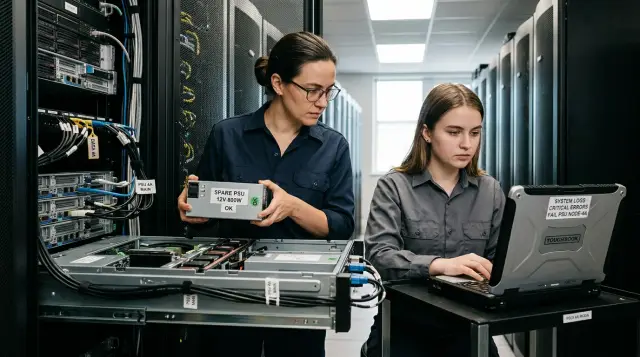
A server rarely fails at a convenient time. When a node cannot complete POST, the on-call engineer does not care how much procurement saved. They need a remote console before the operating system loads, an event log, a clear diagnostic sequence, and a replacement part that is already on its way to their city.
That is why a cheaper Supermicro server cannot be compared fairly with HPE ProLiant or Dell PowerEdge using only processors, memory, and disks. The price gap often hides different BMC licenses, warranty boundaries, spare-parts coverage, and incident ownership. Sometimes Supermicro remains the best purchase after those factors are counted. Sometimes the savings vanish after the first outage.
My working conclusion is simple: buy a measurable recovery scenario, not a badge. The quote must say who takes a call at night, who diagnoses the fault, where a compatible power supply is stored, and how many hours it will take to restore the server. If the seller answers in generalities, the low price has not proved anything yet.
Compare the delivered package, not the server line
A fair comparison starts with the same configuration and the same supplier responsibility. Two servers with the same CPUs, amount of RAM, and usable RAID capacity can differ in price because of network adapters, the storage controller, redundant power supplies, rails, cables, a remote-console license, and on-site service. Remove those lines from one specification and it immediately looks more attractive, but it is now a different package.
First, normalize the offers against one bill of materials. For every server, record exact part numbers, the number of memory modules, the RAID controller model and protected cache, drive types, network ports and optics, two power supplies, rails, TPM, the BMC license, the firmware-update period, and the service package. The phrase "equivalent or better" is useless here: an engineer cannot use it to verify whether a spare drive will be compatible three years later.
Check platform limits as well. One chassis may support the required number of GPUs only with particular risers and power supplies. A second processor sometimes requires a separate heatsink, fans, and application-software licenses. Supported memory capacity depends on the CPU generation, DIMM type, and channel population. The price of an empty chassis says nothing about the cost of a working configuration.
I use a short normalization table:
| What to compare | What to put in the request | How to prove it |
|---|---|---|
| Compute | CPU, DIMMs, speed, installation layout | Configurator and specification |
| Storage | Controller, cache, drives, bays, cables | Part number for every item |
| Remote management | KVM, virtual media, Redfish, license | BMC feature matrix |
| Warranty | Parts, labor, on-site visit, coverage hours | Manufacturer terms and contract |
| Recovery | Response, delivery, and repair time | SLA with exclusions |
Request the final configuration in a machine-readable format, or at least in a table with part numbers. This makes it possible to check that the offer did not lose its iLO Advanced or iDRAC Enterprise license, cache-equipped controller, or second power supply during negotiations. Most "discounts" appear in details like these.
The comparison should cover at least five years of operation even if the budget is approved for the current year. Add support renewals, BMC licenses, a local spares kit, integrator labor, scheduled updates, regional travel, and the expected cost of downtime. Market prices change quickly, so someone else's finished TCO table is almost always misleading. Your support rates and cost per hour of outage produce a more honest result.
Everyone has remote access, but the capabilities differ
All three platforms can control power and read hardware sensors outside the operating system, but "has IPMI" does not mean complete incident access. An on-call shift needs an HTML5 console, ISO mounting through virtual media, a lifecycle log, service-bundle collection, account management, directory integration, and an API for bulk operations.
Supermicro starts with a BMC that supports IPMI and Redfish. In its official download center, the company divides the management suite into Standard, Basic, Advanced, and Enterprise tiers. Standard needs no license and includes the main utilities. Basic adds features including expanded remote BIOS management and updates, while Advanced and Enterprise open broader fleet-management functions. The question "is IPMI included?" is therefore too broad. Ask for the exact license name and the functions available on the specific board generation.
There is another practical detail. The Supermicro IPMI Utilities page explicitly says that the familiar IPMICFG, SMCIPMITool, and IPMIView tools are not supported on the new X14/H14 and later platforms; the company recommends SuperServer Automation Assistant and SuperServer Management instead. That does not make the new generation worse, but it breaks old automation instructions. Run your own commands on a demonstration server before buying.
HPE calls its package iLO. Standard functions ship with the server, while expanded functions depend on the iLO license. The HPE iLO 6 Licensing Guide says that an installed license does not expire and remains valid for the life of the server; one or three years refers to support for the licensed functions. Buyers easily confuse the support term with the right to use the software, so the specification needs both the license SKU and the support period.
Dell uses iDRAC with Lifecycle Controller for the same role. The official iDRAC9 matrix shows that power control, boot control, and Serial-over-LAN are available at basic levels, while HTML5 Virtual Console and Virtual Media on rack and tower servers require a suitable license. Enterprise also adds functions such as remote syslog, expanded logs, and multiple simultaneous console sessions. A conclusion about one license tier cannot be applied to every PowerEdge server.
Before the tender, ask suppliers to perform the same test:
- Shut the server down through the BMC and turn it on again.
- Open the console before POST and display the hardware event log.
- Mount an ISO from a workstation and boot from it.
- Export inventory and power status through Redfish.
- Show how BIOS, BMC, and RAID-controller firmware is updated without manually hunting for files.
This test takes less time than an argument over presentations and quickly reveals paid functions, browser incompatibilities, and gaps in the supplier's skills.
Managing one server and a fleet are different jobs
A good console for one node does not guarantee convenient management of a hundred nodes. On a single server, an engineer can open the BMC manually, check sensors, and install firmware. A fleet needs configuration templates, inventory, groups, version control, update schedules, role separation, and an audit trail. This is the level at which HPE and Dell often justify their higher price.
iLO and iDRAC are closely tied to their manufacturers' ecosystems. HPE builds management around iLO and centralized operations tools, while Dell connects iDRAC with Lifecycle Controller and OpenManage. Their strength is not a polished web interface, but a coordinated lifecycle: the system knows the node model, its components, applicable packages, and change history. Some capabilities still require a separate license or management product. Demand a license matrix instead of accepting the promise that "centralized management is included."
Supermicro provides standard IPMI and Redfish interfaces, and its software suite also supports groups and automation. The benefit is less dependence on one management stack. The drawback appears when the customer has accumulated scripts from several years, boards from multiple generations, and different BMC versions. A supposedly uniform interface then becomes a collection of exceptions that your engineer or integrator must maintain.
Redfish is useful as a control point because it lets you compare basic operations independently of brand. For example, a request to each demonstration server should return its model, serial number, and state:
curl -sk -u audit_user:secret https://BMC_ADDRESS/redfish/v1/Systems/1 \
  | jq '{Model,SerialNumber,PowerState,Status}'
The response should have roughly this shape:
{"Model":"server-model","SerialNumber":"serial","PowerState":"On","Status":{"Health":"OK","State":"Enabled"}}
The resource path and set of fields may differ, so retrieve the Redfish root document first and do not hard-code /Systems/1 into every script without checking. The test account should have read-only permission. Do not keep the example password in shell history or a repository; production automation should retrieve it from a secrets store.
Ask for the same information to be exported from twenty nodes at once, then change one safe setting on a test group and show the audit log. If the supplier can demonstrate only the web console of one server, the operating cost of the fleet has not been counted. If your team already uses Ansible and Redfish, Supermicro's open automation may be more rational than a proprietary package. If the operations team is small, a ready-made HPE or Dell management environment often earns back its license cost.
Firmware needs its own plan for the entire service life
A server is not maintainable if the supplier cannot explain where to get validated BIOS, BMC, RAID, and network firmware four or five years later. Hardware warranty and access to updates do not always follow the same rules. Before buying, define the publication period for fixes, the right to obtain them, the signature-verification method, and responsibility for package compatibility.
HPE and Dell benefit from catalogs tied to a specific model and serial number, together with lifecycle tools. This reduces the chance of installing a file for a neighboring revision. An automatic manufacturer recommendation does not remove the need for testing: new firmware can change the behavior of a driver, fan, network card, or hypervisor. The operating process needs a test node, an observation window, and a clear rollback.
Supermicro publishes BIOS, BMC, drivers, and utilities by platform. Its Security Center lists advisories and protective features by generation, including signed firmware and a hardware root of trust on supported families. The company also states there that some capabilities do not apply to every model and configuration. A reference to the X13 or X14 family therefore does not prove that a selected board has a particular function. Check the manual and BMC version for the exact SKU.
Create a firmware record for every reference server. It should contain the current approved version, file source, checksum, test date, compatible drivers, known limits, and rollback procedure. Keep installation packages inside the organization when the license permits it. During an incident, the external portal may be unavailable, an account may lose its entitlement, or the required old version may disappear from the main list.
Do not update every component at once merely to make the version numbers match. Address a confirmed vulnerability or defect first, then test dependent components. Save the array configuration separately for a RAID controller, verify local accounts and network settings before changing the BMC, and export BIOS settings before an update. Start a fleet update with one noncritical node, then move to a small group.
In the tender, ask for the complete cycle on a demonstration machine: find the applicable update, verify its signature, install it with the standard tool, confirm the version through the API, and restore the configuration after a reset. Then ask the uncomfortable question: who handles a failed update when the operating system will not boot and the BMC responds erratically? The answer should name a support channel, diagnostic data, and a board-recovery method, not advise you to "try again."
The platform price should include the labor for this process. If HPE or Dell lets a small team update a fleet through one validated package, the premium may be justified. If the organization already maintains its own repository, tests Redfish automation, and limits the number of configurations, Supermicro can deliver the same manageable result for less. Savings come from a mature process, not from assuming firmware updates will never be needed.
Clarify what happens to equipment after primary support ends. Ask whether the latest packages, security bulletins, and documentation will remain available, whether service can be extended for one year, and who will diagnose a discontinued board. For a system with a planned seven-year life, this period can cost more than the first three years. It is sometimes cheaper to buy a spare node of the same revision in advance than to search for a rare board later and restore compatibility under incident pressure.
A warranty does not promise the recovery time you need
A warranty answers whether the manufacturer accepts a defect and what it will replace. An SLA answers when the supplier will respond, arrive, and restore the system. The two documents solve different problems. A three-year warranty without a local part may provide a valid replacement on a schedule the business cannot tolerate.
Supermicro's standard terms make this distinction especially clear. The Supermicro Limited Warranty table for rackmount SuperServer systems lists three years of labor, one year of parts, and one year of advance cross-ship unless the invoice sets different terms. The customer first obtains an RMA and sends the defective product under the manufacturer's procedure. That is not the same as an engineer arriving in Almaty or Astana with a spare motherboard within four hours.
HPE terms for EMEA list three years of parts and on-site labor with next-business-day response for many current ProLiant Gen11 systems. The table contains exceptions by series and generation, however, and standard hours are usually limited to business days. Expanded HPE Services add options for coverage and recovery time. The statement "HPE includes three years NBD" is therefore not true for every device and does not mean round-the-clock repair.
With Dell, the term and delivery method also depend on the model, country, service package, and Service Tag. Under the Customer Replaceable Unit program, the manufacturer may ship a part to the customer for self-replacement after diagnosis. An engineer visit depends on the selected support level and the type of part. The ProSupport name in an offer must therefore come with a full description of coverage, site addresses, and term.
Separate four timings in the contract:
- confirmation that the case has been received;
- start of qualified diagnosis;
- delivery of the required part to the site;
- restoration of operation or provision of a replacement node.
A supplier can answer an email within fifteen minutes and still spend a week shipping a motherboard. An attractive response time then does not protect the service. Each metric needs its own coverage hours, rules for stopping the clock, and compensation for a breach.
Check when the warranty starts. Supermicro ties it to the date of the manufacturer's invoice, while delivery and storage may happen before the customer commissions the equipment. Other sales channels can also have a gap between shipment and installation. Fix the service start date in the commissioning certificate or require an entitlement correction. After acceptance, check every serial number in the support system while the supplier can still correct an error.
Only a stock record proves spare-parts availability in Kazakhstan
No one can honestly declare one brand the easiest for parts everywhere in Kazakhstan. Actual availability depends on the city, server generation, partner status, service contract, and the inventory of a specific integrator. Even a popular brand does not help when the required motherboard is allocated to another country or removed from the local reserve.
HPE and Dell have an advantage where an authorized channel actually holds parts and can process delivery under the entitlement. Their catalogs, serial numbers, and replacement procedures usually reduce disputes over compatibility. A logo on the quote still does not prove there is stock in the country. Ask for the legal entity responsible for service, the warehouse address, the list of parts, and the release procedure at night or on weekends.
Supermicro uses many components that come from standard industry families, and an integrator can sometimes keep an economical spares kit with power supplies, fans, drives, cables, network cards, and even a complete compatible node. Motherboards, backplanes, expanders, risers, and firmware still depend on the exact platform. An attempt to substitute a "similar" part during an incident often ends in a second fault or an unsupported configuration.
For a critical system, add a spare-parts appendix to the contract. It should list the part number, quantity, storage location, owner, access hours, maximum delivery time, and replenishment rule after use. It helps to divide spares between site and central stock: keep drives, fans, and power supplies next to the equipment, while expensive boards and complete nodes remain at a regional center.
Do not accept "parts available to order" without a timeframe. Ask whether a part ships from a warehouse in Kazakhstan, a neighboring country, or the factory, who handles customs, and what happens if it is delayed. Government and financial customers should also check engineer-access procedures, seals, media handling, and removal of the defective part. Stock can exist while the site's internal security process adds a day.
Run a spot check before signing. Name three parts from the final specification: a power supply, RAID controller, and motherboard. Ask for current stock, delivery time, and a replacement part number. Then put the promised times into the contract. A salesperson's verbal answer should not be the only foundation of an incident plan.
Support quality appears in one rehearsed incident
Support should be judged by how the team diagnoses a fault and transfers responsibility, not by the number of telephone numbers on a website. Rehearse a failure before acceptance: the server powers on but cannot see its boot volume after RAID-controller warnings. The operating system is unavailable, the application is stopped, and physical access to the site is restricted.
A good first line immediately records the serial number, configuration, service impact, and recent changes. The engineer then connects to the BMC, saves the System Event Log and controller log, and checks the drives and cache battery without clearing warnings. They do not suggest updating every firmware package at random on the failed node. The team first preserves evidence and rules out actions that would make recovery harder.
On Supermicro, the engineer may collect data from the BMC, IPMI, and manufacturer utilities. On HPE, they use iLO and platform service logs; on Dell, iDRAC and Lifecycle Controller. The names differ, but the result should be the same: a bundle containing inventory, versions, hardware events, and a clear hypothesis reaches the next-level specialist. If the first line passes the customer between the manufacturer and integrator without one case owner, the technical advantage of the BMC disappears.
The scenario must end with a specific resolution. For example, support confirms controller failure, reserves a compatible part, gives the engineer's arrival time, agrees on the work window, and prepares instructions for preserving the RAID configuration. After replacement, the team verifies the array, operating-system boot, and monitoring status, then issues a report with the cause and measures against recurrence.
During the exercise, measure more than minutes. Check these signs:
- whether the case channel accepts Russian and Kazakh if your shift requires them;
- whether a qualified line is available during the stated hours;
- whether support can see the configuration, contract, and node history;
- whether one coordinator can manage the manufacturer, warehouse, and visit;
- whether the work leaves a technical report rather than only a "closed" status.
HPE and Dell often provide a more formal escalation path under a paid service. Supermicro with a capable local integrator can provide a shorter chain and more freedom in repair. A weak partner turns that freedom into an obligation for the customer to collect logs, investigate compatibility, and argue about the RMA. Compare the actual service teams, not the global reputation of the brands.
Cheaper to buy does not always mean cheaper over five years
Total cost includes hardware, licenses, support, spares, team labor, and outage losses. The last component often changes the decision, but buyers either ignore it or substitute a made-up "average cost of downtime." Use your own financial model: how many transactions, appointments, classes, or internal operations stop with one server.
A simple formula looks like this:
TCO = закупка + лицензии + сервис + ЗИП + труд эксплуатации + стоимость простоев
Стоимость простоя = часы недоступности × потери в час
Calculate at least three scenarios: scheduled operation without major failures, one failure of a replaceable part, and one motherboard failure outside business hours. Use contract times for each brand, not promises. If the SLA mentions only response, recovery time remains unknown. A conservative model should use the part-delivery time plus the access and repair window.
Suppose a company buys twenty nodes. Offer A is cheaper by ΔP, but it needs a separate BMC license L, a spares kit S, and H extra engineer hours each year at rate R. The five-year advantage is:
Экономия = ΔP - L - S - (5 × H × R) - разница в потерях от простоев
This is not a failure forecast or a universal coefficient. The formula identifies the disputed values. Procurement can confirm ΔP, IT can estimate H, the business can provide loss per hour, and the supplier must confirm recovery times. If a value is unknown, the decision contains a risk that should be named instead of hidden as zero.
An HPE or Dell premium often buys predictability: one catalog, mature logs, a known escalation path, and a contracted site visit. It is justified when downtime is expensive, there are many sites, and there are few engineers. Expensive support without inventory in the required region remains an expensive promise. Local execution must also be tested for major brands.
Supermicro often wins where the team can automate through Redfish, standardizes on two or three configurations, holds its own spares, and works with an integrator that actually repairs servers in Kazakhstan. In that model, the customer consciously takes part of the operational responsibility and controls cost. Buying the same platform without those conditions solely for a low CAPEX line is dangerous.
Supermicro does not suit every workload, and neither does a premium brand
Supermicro is a rational choice for clusters where the application tolerates losing a node, the equipment is standardized, and a spare server can quickly join the pool. Availability in that environment comes from architecture and automation. Paying a premium for a four-hour repair of every node may be unnecessary because the service keeps running during replacement.
The same logic fits laboratories, HPC, and AI infrastructure where density, accelerator choice, and configuration flexibility matter and the engineering team understands hardware. Flexibility also raises the demands on configuration management. The more boards, risers, network cards, and firmware variants you allow, the more expensive the spares kit becomes and the harder nodes are to reproduce. Limit the number of reference configurations and freeze their BOMs.
HPE or Dell is usually easier to justify for isolated critical systems, remote branches, and environments with a small team. If one server failure stops a medical system, financial operation, or government service, a contracted visit and clear escalation may be worth more than the purchase-price difference. A cheap spare node also helps, but it must be installed, synchronized, and tested regularly.
Do not buy HPE or Dell merely for a sense of safety. A basic warranty does not replace the required SLA, an entry license may not provide a remote console, and a partner without local inventory cannot create a part from a logo. Supermicro should not be dismissed as an "unsupported kit" either: the result depends on the configuration, licenses, and integrator. Both caricatures prevent a sound tender.
Tie the choice to the workload class:
| Conditions | What usually carries more weight |
|---|---|
| Cluster tolerates a lost node | Price, standardization, and a spare node |
| One server runs a critical service | Guaranteed recovery and a site visit |
| Many remote sites | Local service network and simple escalation |
| Strong automation team | Redfish, APIs, and configuration freedom |
| Strict change control | Lifecycle logs and one management environment |
This is not an automatic selection table. It shows which part of the offer deserves deeper checking. Workload architecture should determine the service package, rather than a habit of buying one brand for every task.
Verifiable commitments determine the winner
A final decision does not require faith in marketing language. Give bidders one specification, one remote-management test, and one incident scenario. Then score the complete price, licensed functions, update period, warranty coverage, local spares, and the four SLA timings. The supplier must attach manufacturer documents and accept responsibility for every discrepancy.
Give recovery a high weight in the scoring protocol when the workload is critical. A point for "has a service center" means nothing. Points should be earned for a named warehouse, stated coverage hours, delivery time for specific parts, qualified support, and the result of a trial case. The committee then compares execution rather than brand recognition.
GSE manufactures S200 servers in Kazakhstan and works as a vendor-neutral systems integrator with 24/7 support and a nationwide service network. In a comparison project, that makes it possible to request a local configuration and support option alongside global alternatives, but the SLA, spares list, and compatibility still need to be fixed by part number and site.
Before signing, obtain five appendices: the final BOM, a matrix of BMC functions and licenses, a list of supported firmware, a spare-parts table, and an incident procedure with an SLA. Run an acceptance test on the actual server, record the versions, and save the configuration export. Make correction of identified discrepancies a condition of payment.
Supermicro loses only the elements that are actually removed from the specific delivery along with the price. That may be a license, a site visit, a local board, ready-made automation, or one incident owner. If the integrator restores those elements at a reasonable price and proves them in a test, the savings are real. If they are absent even from the contract, the organization is buying future incident work for its own team.
Frequently asked questions
Why is Supermicro usually cheaper than HPE and Dell?
The gap often comes from configuration, management licenses, and service rather than the chassis alone. Compare identical BOMs, BMC functions, and recovery times, or the prices describe different products.
Does Supermicro require a separate remote-console license?
It depends on the platform generation and the function you need. Ask for the exact license tier and demonstrate KVM, virtual media, BIOS updates, and fleet management.
Is the remote console included with a basic iDRAC license?
HTML5 Virtual Console and Virtual Media on rack and tower PowerEdge servers require a suitable licensed tier. Do not rely on the word iDRAC in a specification; check the feature matrix for the exact model.
Does an HPE iLO Advanced license expire?
HPE documentation says an installed license remains valid for the life of the server. The one or three years in the name refers to support for licensed functions, which can later be renewed.
What does the standard Supermicro warranty cover?
Terms depend on the SKU and invoice, but the standard table for rackmount SuperServer systems lists three years of labor and one year of parts. Check advance cross-ship as well, and do not treat an RMA as a promise of on-site repair.
Are parts for all three brands available in Kazakhstan?
There is no universal answer because inventory depends on the partner, city, model, and service contract. Require a part-number list, warehouse address, and maximum delivery time in the contract.
How is a warranty different from a support SLA?
A warranty defines the right to repair or replacement for a defect. An SLA sets intake hours, response, part delivery, and recovery time when those metrics are written explicitly into the contract.
When is Supermicro better value than a premium brand?
It often makes sense in a resilient cluster with a capable team, standard configurations, and an owned spares kit. The savings are doubtful for one critical server without local support.
How can support quality be tested before purchase?
Rehearse a RAID-controller or boot failure and open a real test case. Measure diagnosis, escalation, part search, visit coordination, and the quality of the final report.
What must a server tender include?
Attach an exact BOM, BMC-license matrix, warranty terms, local-spares list, and incident procedure. State response, part-delivery, and full-recovery times separately.