8 min read
What does ISO 45001 say about an equipment manufacturer?
Learn what ISO 45001 confirms, how to check a certificate's scope, and which factory working conditions a buyer must inspect firsthand.
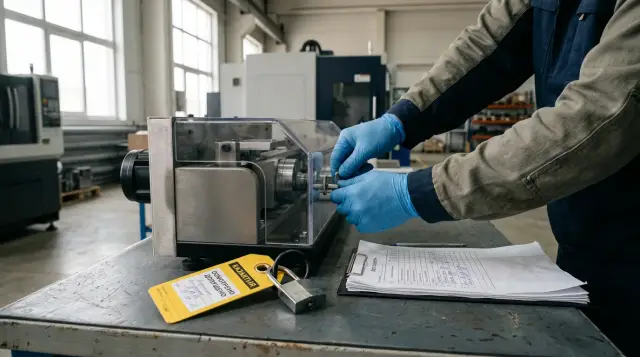
An ISO 45001 certificate gives a buyer a useful signal: the manufacturer has built an occupational health and safety management system, and an independent body has assessed it against the standard. But the certificate does not show whether a particular machine guard is closed, whether local exhaust ventilation works at the soldering station, or whether the night shift follows the same procedure described in the manual.
There is no need to choose between a certificate and your own audit. The certificate first filters out suppliers without a systematic approach, then a document review and factory visit answer questions that certification does not have to cover for a particular purchase. When a buyer accepts a PDF as proof of safe production, the buyer is checking a file rather than a manufacturer.
A certificate and an audit answer different questions
ISO 45001 confirms the presence of a managed occupational safety process, while a supplier audit confirms the condition of a selected site at a selected time. These two kinds of evidence overlap, but they do not replace each other.
The standard requires an organization to identify hazards, assess risks, account for mandatory requirements, set objectives, train workers, prepare for emergencies, investigate incidents, conduct internal audits, and review the system at management level. Worker participation is an important part of the standard: the people doing the work must be able to report hazards and influence occupational safety decisions.
A certification body assesses the system by sampling. It studies documents, interviews people, visits sites within the certification scope, and checks records. ISO/IEC 17021-1 explicitly classifies management system certification as third-party conformity assessment and sets requirements for the competence, consistency, and impartiality of certification bodies. This is stronger than a supplier's letter saying "everything is safe here," but the sample remains a sample.
A buyer's audit is a second-party audit: the customer or its representative checks a prospective supplier for a specific contract. The audit can focus on the buyer's order, the relevant workshop, actual shift patterns, contractor work, and the risk of supply interruption. It does not issue a new certificate and should not pretend to be a full recertification.
Another distinction often gets lost: ISO 45001 concerns people's health and safety at work. It does not certify the safety of a computer, server, or other product, replace product testing, or prove technical quality. A safe factory can make a defective product, while a good sample can come from poorly managed production. The buyer must keep these lines of evidence separate.
Establish certificate authenticity before the visit
Verification starts with the chain that gives an independent assessment its credibility, not with an ISO logo. Ask for a complete copy of the certificate and its annexes, not a screenshot of the first page in a presentation.
Record these fields in a working note:
- legal name and address of the certified organization;
- certificate number, standard, and applicable edition;
- certification scope, sites, and annexes;
- initial certification date, issue date, and expiry date;
- certification body name and accreditation mark.
Next, check the certificate in the certification body's register or ask that body for written confirmation. Separately establish whether the body is accredited to certify occupational health and safety systems in the relevant country and against the relevant standard. A polished mark on a PDF proves nothing by itself. The body name, document number, status, and scope must match across all sources.
A useful verification result is a short record that another employee can reproduce:
Сертификат: KZ-OHS-0000
Организация: юридическое лицо поставщика
Стандарт: ISO 45001:2018
Площадка заказа: адрес указан / не указан
Область: производство компьютерного оборудования / иная формулировка
Статус в реестре: действует / приостановлен / не найден
Аккредитация органа: подтверждена / требует уточнения
Проверил: имя, дата, источник подтверждения
The number is fictional, but the format is practical. It prevents a familiar mistake: procurement saves the certificate, and six months later nobody remembers whether anyone checked its status, whether the factory was in scope, or why the document was accepted.
A suspended, withdrawn, or unlisted certificate should not automatically be called fake. A register may update slowly, the legal entity may change, or the certification body may be moving data. Until the supplier explains the discrepancy in writing and the body confirms it, however, the document should earn no qualification points.
Scope matters more than a familiar logo
The scope answers a practical question: did the certification body assess the activity and site where your order will be made? The wording "manufacture of computer equipment" is more useful than the broad phrase "sale and maintenance of equipment" when the contract covers serial server assembly.
Compare four things: the legal entity in the contract, the certificate holder, the manufacturing site address, and the stated production process. A matching brand does not mean the organization matches. A corporate group may show a head office certificate even though assembly is performed by another company, an outside contractor, or a site that does not appear in the annex.
Multi-site certification does not mean that an auditor saw every factory at the same depth on every visit. Request a list of covered sites and ask which ones were visited during the initial, surveillance, and recertification audits. The buyer does not need confidential audit details, but does need clarity on whether the order's factory is part of the system's current sample.
Check the boundaries of the activity. Equipment manufacturing can involve component purchasing, warehousing, assembly, metalwork, electrical testing, packaging, service, and field installation. A certificate may cover only part of this work. If hazardous operations are outsourced, ask how the manufacturer selects the contractor, communicates requirements, oversees the work, and responds to deviations. Outsourcing an operation does not transfer responsibility for managing the associated risk within the supply chain.
Finally, do not ask for an "ISO 45001 product certificate." That phrase should not appear: an organization's management system is certified within a defined scope. Products have their own technical requirements, tests, and documents. A supplier that deliberately mixes these concepts in a commercial proposal has already given you a reason to widen the review.
Auditor competence must match the production process
A person with general audit experience can test the logic of a system, but factory hazards demand process knowledge. An auditor who cannot distinguish a normal test rig from a dangerous improvisation may collect tidy records and miss the main risk.
Choose the team after reviewing the process map. A computer equipment factory may require knowledge of electrical safety, machine safety, industrial ventilation, ergonomics, chemical handling, fire preparedness, and warehouse logistics. One person is rarely equally good at all of them. For a complex order, adding a specialist for part of the route is better than expanding the questionnaire with questions nobody can evaluate properly.
Independence also has a practical limit. A buyer's employee knows the contract and supplier history, but may defend a commercial choice that has already been made. An external expert is freer to reach a conclusion, but understands the criticality of a particular operation less well. A workable arrangement separates the roles: the procurement owner provides context, the safety specialist assesses the system, the technical expert checks hazardous operations, and an appointed committee makes the final decision under predefined rules.
Before the visit, record the team's competence next to the audit topics:
- scope of review and related production risk;
- participant qualified to assess that risk;
- verification method: document, interview, observation, or measurement;
- limitation that will require another specialist;
- person responsible for the final conclusion.
This sheet does not need to be long. It prevents the team from discovering after the visit that nobody checked the exhaust system because the auditor saw it as a maintenance issue and the engineer saw it as a safety issue.
Measurements require separate discipline. An auditor may notice noise, fumes, or poor lighting, but an impression cannot replace an instrumented assessment. If a conclusion depends on exposure level, request the measurement results, method, sampling points, date, process condition, and provider's competence. If doubt remains justified, propose a repeat measurement by an agreed party. Do not call something an exceedance when the team has neither measured it nor compared it with the applicable limit.
Disclose conflicts of interest before the review. A consultant who built the supplier's system should not then give the buyer an independent opinion on that same work without declaring the role. In the same way, certification under a familiar international name does not remove the need to check the particular body and auditor. Trust depends on a transparent chain of competence, not a title beneath a signature.
A working system leaves a connected evidence trail
A good review follows one real hazard through the entire management cycle instead of reading a stack of unrelated instructions. Select two or three risks characteristic of the site and ask to see the chain of decisions for each one.
For example, the trail at an electrical testing station may look like this:
- The organization identified contact with hazardous voltage as a hazard and determined who could be exposed.
- The risk assessment led to engineering measures: guarding, interlocking, a safe test fixture, and access control.
- The procedure described authorization, the pre-use check, and the response to a fault.
- Workers received training, while the supervisor checks performance through observation, inspection, or measurement.
- An incident, equipment change, or scheduled review triggers a new assessment and corrective action.
A record or observation should support each transition. A risk register with no link to equipment shows a paper assessment. A guard without maintenance and testing may fail. A signature in a training log does not prove that a worker understood the restriction. A conversation with the operator connects the documents to the actual work.
Ask to see one closed corrective action. It should contain a description of the nonconformity, cause analysis, responsible person, due date, completed action, and effectiveness check. A photograph of a new sign proves only that the sign was installed. If the cause was an awkward route for moving heavy products, effectiveness must be checked against the route itself, people's behavior, and repeat reports, not the presence of a photograph.
ISO 19011 gives guidance on audit principles, program management, and auditor competence. Its value to a buyer is not an invitation to copy a certification body's procedure. The standard disciplines an in-house review: define criteria and the sample in advance, collect verifiable evidence, separate fact from conclusion, and record uncertainty. ISO published a new edition of ISO 19011 in 2026, so audit templates should be checked against the current edition instead of copying an old form forever.
Inspect the work, not the visitor route
The visit lets you compare the established procedure with the way people actually make equipment. Ask to follow the material flow: receiving, warehouse, preparation, fabrication or assembly, testing, packaging, and dispatch. This route exposes handoffs between departments that a presentation usually hides.
In enclosure fabrication, examine moving-part guards, emergency stops, chips, sharp edges, noise, tool changes, and energy isolation during maintenance. In assembly, check workstation layout, manual handling, repetitive movement, cables across walkways, and access to first aid. At a soldering or repair station, check local exhaust ventilation, chemical handling, container labels, and access to safety data sheets. Electrical testing requires zone separation, serviceable fixtures, worker authorization, and a clear response to faults.
Do not turn the visit into a hunt for a missing glove. Personal protective equipment sits below engineering and organizational measures in the hierarchy of controls. If a worker constantly compensates for a hazardous design with goggles, gloves, and caution, ask why the hazard cannot be eliminated, isolated, or reduced through engineering.
Inspect nonproduction areas. Loading bays, battery charging, temporary waste storage, stairs, welfare rooms, and evacuation routes often fall outside the prepared tour. Ask to see one area of your choice and one operation under normal workload. A refusal without a reasonable explanation does not prove a violation, but the restriction should be recorded as an evidence gap.
The shift matters too. The day team may work with the safety engineer and a full group of supervisors present, while control becomes weaker in the evening. For a critical order, ask about schedules, the share of night operations, shift handover, and access to responsible staff. A remote interview with another shift's supervisor and a sample of its records may be enough, or a return visit may be necessary.
Workers reveal the gap between procedure and habit
Workers show faster than documents whether the system functions without audit preparation. Speak without the immediate supervisor present and do not ask people to identify who is at fault. The aim is to test reporting and response.
Ask an operator simple questions: what hazards exist in this operation, what changed after the last assessment, how to stop work when danger appears, whom to tell about a near miss, where to find the procedure, and what to do when a safeguard fails. When it is safe, ask the person to demonstrate the action rather than repeat a memorized phrase.
Compare answers from a permanent worker, a new hire, and a contractor's employee. They may have different induction, access to reporting channels, and authority to stop work. A system that serves employees well but leaves temporary staff without a clear channel does not control the site's actual workforce.
Pay particular attention to protection from retaliation. A formal reporting card is useless if people believe a complaint will hurt their bonus or their relationship with a supervisor. Do not ask directly, "Are you punished?" Ask about the most recent report, who made it, what happened afterward, how the decision was communicated, and whether the person continued working in the same area. A consistent, specific account is stronger than a general assurance.
Worker participation is not a signature in a committee minute. Look for influence: an operator proposed changing table height, the warehouse reported a blind spot at a gate, or an electrician secured a different authorization process. Then check whether the manufacturer assessed the proposal, explained the decision, and measured the effect. Management does not have to accept every idea, but it must not imitate consultation.
Statistics mislead easily without primary records
Zero injuries alone do not prove safe production. The figure may reflect good control, a small amount of work, a narrow definition of a recordable case, or reluctance to report. The buyer needs the reporting rules and the quality of the response, not one attractive indicator.
Take a small sample for one agreed period: a recorded injury, a near miss, a hazardous-condition report, and a planned inspection result. Trace each case from registration to decision. Compare dates, classification, medical care where applicable, notification of responsible people, cause analysis, actions, and closure checks. A buyer does not need personal medical data, which can be anonymized.
Weak analysis ends with "the worker was careless." That phrase does not explain why the system allowed contact with the hazard. Ask about layout, pace, lighting, tool condition, clarity of the task, training, supervision, and earlier signals. Human error may be an event in the chain, but it rarely works as the sole cause.
Check overdue actions and repetition. If three inspections find a blocked aisle and staff simply clear it each time, the organization is treating a symptom. It needs the reason for recurrence: storage space, removal schedule, markings, responsibility, or flow planning. A closed card attached to an open risk should count as an open action.
Do not demand "perfect" statistics from a supplier. Demand honest recording, priorities based on risk level, and demonstrated learning from events. A manufacturer that shows an uncomfortable case and clearly explains the process change inspires more confidence than one that has recorded no near misses for years.
A four-hour audit can avoid a shallow questionnaire
A short audit works when the buyer limits the objective in advance and requests evidence. An initial qualification of an equipment manufacturer can allocate four hours: an opening meeting, certificate review and two risk trails, a production walk, worker interviews, and a closing meeting. This is not a universal duration, but a practical format for a moderately sized site; a complex factory or critical order will require more time and specialist expertise.
Send a program several days ahead with the criteria, boundaries, participants, and document list. Ask for the certificate and annexes, a map of processes and sites, the significant risk register, information on recent internal audits, a sample of corrective actions, the emergency response plan, and contractor management rules. Do not request the whole archive: too many files make it harder to select evidence.
At the opening, confirm where the order will be made, which operations the supplier performs, which ones it outsources, and which areas cannot be visited. Agree on photography rules, confidentiality, protective equipment, and escorts. Then select risks after a short process overview instead of letting the supplier present only exemplary folders prepared in advance.
Use one line for each observation:
Критерий | Свидетельство | Вывод | Риск | Требуемое действие | Срок
ISO 45001, управление изменениями | Новая испытательная установка введена 12.05; оценка риска датирована 20.05 | Оценка выполнена после запуска | высокий | пересмотреть допуск и проверить аналогичное оборудование | до решения о заказе
The dates in the example are fictional. The line is strong because its logic is transparent: a reader can see the criterion, fact, and reason for the conclusion. Do not write "occupational safety is weak." Record exactly what you observed, whom you asked, which document you checked, and what was missing.
At closing, separate nonconformities, observations, and access gaps. The supplier should understand the wording and have a chance to correct a factual error, but the supplier does not choose the final rating. Ask for an action plan only on material points. Minor comments must not hide an electric shock risk, failed exhaust ventilation, or the systematic absence of reports.
Purchasing decisions should follow risk, not a score
The audit outcome should change the decision, contract terms, or control plan. If the report merely sits beside the certificate, the buyer has spent time creating one more document.
Divide outcomes into three groups. Green means the certificate is confirmed, the site and activity are in scope, the sampled trails work, and there are no critical deviations. Yellow means evidence is limited or deviations can be corrected: the order may proceed after an agreed plan, closure confirmation, or tighter acceptance control. Red means an immediate serious hazard, false information, a site outside the stated scope, or a recurring system failure to manage a high risk. The decision is then deferred until the cause is removed and the result is checked again.
Do not average a critical risk against ten good questionnaire answers. Correct training logs do not offset access to exposed live parts. By the same logic, one poorly completed form should not automatically disqualify a supplier if the actual control works and the record can be restored. The potential harm and the systemic nature of the finding determine its weight, not how easy it is to calculate.
Keep the decision connected to the underlying evidence. In the qualification register, record the report version, committee date, accepted restrictions, open actions, and next review date. If the supplier changes sites, gives a hazardous operation to a new contractor, or changes the process, the contract owner must see that the old assessment no longer describes the supply. Without this connection, green status outlives the facts that supported it.
Verify closure according to the risk. A corrected record may need only the document and confirmation from its owner. A new guard, exhaust system, or authorization process requires photographs, technical documents, a worker interview, or a return visit. A supplier can submit a plan on time without carrying out the measure, so "plan accepted" and "risk closed" must have different statuses.
Set an expiry period for qualification. It depends on order risk, process stability, results of earlier reviews, and supplier changes. A repeat audit need not reproduce the first one: check open actions, new processes, recent incidents, and the highest-risk operations. Between visits, a certificate status change, production move, or major technology change may trigger an unscheduled review. This keeps control tied to production rather than the archive calendar.
Tell the manufacturer the rules before signing the contract. When the criteria for red, yellow, and green decisions are known in advance, the discussion focuses on evidence and risk instead of bargaining over points after the audit. The buyer gets comparable decisions, and the supplier knows which evidence will remove a restriction.
The contract can require the supplier to maintain valid certification in the agreed scope, report certificate suspension or change, notify the buyer of a production move, and allow an agreed audit. The clause should state the notice period, consequences, and protection of confidential information. A lawyer adapts it to the contract and applicable law; the auditor determines which changes affect supply risk.
At GSE, ISO 45001 certification complements control of the full production cycle across three sites in Kazakhstan, but a buyer should still compare the certificate scope with the factory and operations for the order. That question does not express distrust. It shows that the buyer understands what the certificate is for.
A supplier with a working system will answer with facts: name the site, disclose the scope, walk through the flow, allow conversations with people, and show how an uncomfortable event led to a process change. If the buyer receives only a colorful PDF instead of that chain, the decision still lacks evidence.
Frequently asked questions
Does ISO 45001 replace a supplier audit?
No. The certificate confirms a management system within its stated scope, while the buyer's audit checks a particular site, order operations, and actual performance. Material production risk requires both levels of review.
How do I verify an ISO 45001 certificate?
Compare the legal entity, number, standard, scope, sites, validity period, and certification body. Then confirm the status in the body's register or by written request, and separately check its accreditation for this type of certification.
What if the certificate was issued to the parent company?
Check whether the factory and the performing legal entity appear in the certificate or its annex. A shared group brand does not prove that the system covers the site making your order.
Does ISO 45001 certify equipment as a safe product?
No. ISO 45001 concerns occupational health and safety within the organization and does not replace technical regulations, product testing, or product conformity documents. Review that evidence separately.
Can I qualify a manufacturer without visiting the factory?
You can conduct a preliminary document review and remote interviews when risk is low. For a critical order, remote review leaves gaps because it reveals little about bypassed safeguards, work area conditions, or shift behavior.
Which documents should I request before a safety audit?
Request the certificate and annexes, site and process map, significant risk register, recent internal audits, a sample of corrective actions, and contractor rules. Select a useful sample instead of asking for the whole archive.
Whom should I interview during a manufacturer audit?
Speak with the production manager, safety specialist, an operator, a new hire, and, where possible, a contractor's employee. Different roles show whether the system works beyond the prepared group.
Does zero injuries mean a factory is safe?
Not necessarily. First check reporting rules, near-miss reports, and primary records. Honest investigation and removal of causes tell you more than a single zero.
How should I rate identified nonconformities?
Assess potential harm, likelihood, repetition, and systemic reach. Good questionnaire answers cannot average out a critical hazard, while one form error does not equal failure of the whole system.
When can I approve a supplier conditionally after an audit?
Conditional approval fits limited or correctable deviations with no uncontrolled serious hazard. Record the action, owner, due date, closure check, and consequence of failure before placing a critical order.