7 min read
Quantum computing: how it will change software and security
Quantum computing in plain language: what it is, where it can bring breakthroughs, what risks it poses to cryptography and how businesses and developers should prepare.
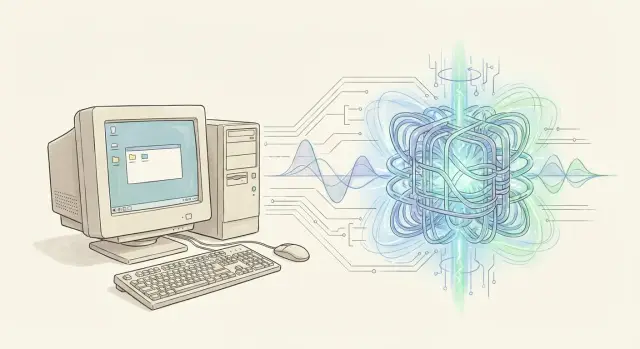
What this is about: why quantum computing is being taken seriously
Quantum computing is not just "faster computers." It’s a different way of solving certain classes of problems where classical machines must try too many possibilities or lose accuracy because of approximations.
Quantum problems are often about probabilities and working with many possible states at once. Where a classical computer follows one path and checks options sequentially, a quantum computer can search for an answer differently — sometimes finding a shorter route in optimization, materials modeling or cryptoanalysis.
Several groups take the topic seriously: scientists (hoping to model molecules and materials more accurately), businesses (money to be saved in logistics, scheduling and risk), governments (communication security and technological independence), and infrastructure engineers (new requirements for data centers, skills and supply chains).
Expectations are often inflated. A quantum computer won’t speed up every piece of code or replace office servers. Many demonstrations today run on small devices, need special conditions and help only in narrow problem classes. Still, practical results are appearing: quantum methods improve parts of some computations, and companies test hybrid approaches where a quantum block assists the classical system.
Most people will notice changes indirectly, through services. A bank might detect fraud more precisely, a logistics firm might recalculate routes faster during disruptions, and medicine might speed up drug discovery. The most sensitive area is security: if large, reliable quantum systems become available, data protection methods will need updating well in advance, especially in the public sector and critical infrastructure.
Basic concepts without the math: qubits and entanglement
A classical bit is like a switch: either 0 or 1. A qubit can be pictured as a coin spinning in the air. Until you catch it, you can’t say whether it’s heads or tails. That’s superposition: a qubit can be in a sense "both 0 and 1" at once.
One caveat: once you "look," that is, measure the qubit, you get a definite result — 0 or 1. The coin lands. Repeating the measurement gives the same answer because the state has collapsed.
Entanglement can be explained with a pair of such "coins" that behave as one unit. Imagine two closed boxes with balls: you open one and see a white ball. At that moment you know the other box contains a black ball, even if it’s far away. In the quantum world the connection is stronger than "we placed them that way": the pair’s properties are defined jointly, and measuring one part instantly sets the outcome for the other.
Because of this, a quantum computer is not just a faster classical machine. Its advantage appears only for particular kinds of problems, where algorithms can amplify desirable answers and cancel out the wrong ones. For other problems, quantum methods may give no benefit or even perform worse.
In practice quantum devices struggle with very earthly issues: noise and errors (states are easily disturbed), loss of entanglement and decoherence, control complexity and precise pulses, and the need for cooling and isolation. Without error correction results remain unstable.
Today quantum computing is therefore more about experiments and narrow uses than about universally replacing classical computers.
Where quantum computers can help — and where they won’t
Quantum computing won’t speed up everything. It excels where a problem boils down to finding the best option among an enormous set, or to accurately simulating molecular processes. For most everyday business software there will be no gain.
Quantum machines look best in three types of problems: simulation (chemistry, materials, sometimes biology), optimization (schedules, routes, resource placement) and finding structure in data (specific mathematical tasks and some approaches in machine learning).
Where you almost certainly won’t see speedups: office apps, web services, accounting, most database queries, rendering, and typical analytics. These run well on classical servers, GPUs and scaled systems; "quantum magic" does not appear here.
What is "quantum advantage"
Quantum advantage means a quantum computer solves a specific problem better than the best classical methods on comparable resources. Proving this is hard: classical algorithms keep improving, fair comparisons require equal conditions, and current quantum devices are noisy and often produce unstable outcomes.
When it’s better to improve ordinary servers
If a task already runs in acceptable time, it’s usually cheaper and more reliable to optimize the classical side: tune code and data, add CPU and memory, install fast disks, move computation to GPUs, or upgrade the server platform (for example, to modern rack servers like the S200).
A practical rule: squeeze the most from classical infrastructure first, and run quantum pilots only where there’s a clear metric of gain and a real pain from current runtimes.
Application scenarios: from chemistry to logistics
Quantum computing is most discussed where you must check too many options or precisely calculate a complex system’s behavior. Classical computers often hit a wall not in speed but in the impossibility of "checking everything" in reasonable time.
Chemistry and new materials
The clearest scenario is molecular simulation. Quantum systems do not fit well into classical approximations, so developing battery materials, catalysts or drugs often relies on costly experiments and long trial‑and‑error cycles.
Quantum models promise better predictions of molecular properties before lab work: which structures are stable, how a molecule will bind to a protein, and what side reactions are likely. In practice this is still mostly narrow cases, small molecules and research demonstrations.
Optimization: routes, schedules, plans
The second major class is optimization: warehouse and delivery logistics, shift and equipment scheduling, production planning, and portfolio selection. The number of possible combinations is usually so large that even good algorithms must settle for compromises.
Quantum approaches can sometimes find better solutions faster or improve approximation quality. A realistic example: a large organization needs daily routing for field crews across the country with deadlines, spare parts and transport constraints. Classical methods solve this today, while quantum prototypes can be tested as accelerators for the hardest parts of the calculation.
Machine learning with caveats
In ML, quantum speedups are discussed for particular subproblems (linear algebra, sampling, optimization). But many conditions apply: data is almost always classical and must be prepared, and improvements aren’t guaranteed.
More realistic near‑term directions: quantum‑inspired optimization on classical servers, hybrid schemes where a quantum module handles a narrow step and the rest is classical, pilots in chemistry and materials with small models, and preparing cryptography for post‑quantum standards while hardware matures.
For companies building infrastructure and data centers, it makes sense to treat quantum computing as a special module alongside existing HPC and GPU resources rather than as a replacement.
Cryptography and security: what might really change
Most modern security relies on problems that are hard for classical computers. For example, RSA depends on the difficulty of factoring large numbers, and many elliptic‑curve schemes rely on a hard discrete logarithm problem. For classical machines these tasks are effectively infeasible at proper key sizes.
Quantum computing changes the picture because of Shor’s algorithm. It theoretically speeds up factorization and related problems, putting RSA and many elliptic‑curve schemes at risk. This does not mean the internet will be broken tomorrow. A real attack requires a large, error‑corrected quantum computer, and timelines are uncertain. Still, the transition to new standards takes years, so the risk is already discussed seriously.
The practical takeaway: prepare for migration to post‑quantum cryptography. These are new algorithms designed to resist quantum adversaries but run on ordinary servers and PCs. For organizations, migration usually means reviewing where and how keys, certificates, VPNs and signatures are used, and updating software and hardware where algorithms are hardcoded.
A separate threat is "collect now — decrypt later": an attacker may capture encrypted traffic now and decrypt it later when quantum resources are available.
It makes sense today to identify long‑lived sensitive data: personal and medical records, state secrets and internal correspondence, financial documents and long‑term contracts, customer databases and research results.
A practical example: a government body updating infrastructure and buying servers (for example, for departmental archives) can plan support for modern crypto algorithms and a certificate update process in advance. This lowers risk even if quantum computing develops faster than expected.
How to get into the topic: a step‑by‑step learning plan for beginners
You don’t need to dive into formulas right away. It’s more important to learn the language: what a state, an operation and a measurement are, and why results often look like probabilities rather than a single exact answer.
Useful starter skills are simple. Linear algebra at the conceptual level: vectors as "directions" and matrices as "transformations." Also algorithmic thinking: breaking problems into steps and spotting parallelism or search.
A practical learning plan:
- Understand qubits, superposition and entanglement with everyday examples, then solidify the terminology.
- Learn what a quantum circuit is: "wires" (qubits), operations (gates) and measurement at the end.
- Look at 2–3 classic quantum algorithms at the idea level: why they speed up search or factorization.
- Learn to read results: why a single run proves little and repetitions are needed.
- Move on to limitations: noise, decoherence and different computation models.
A quantum program is usually described as a circuit: prepare an initial state, apply operations and measure. Remember: measurement collapses the state, so many tricks are done before measuring.
Result evaluation is special. Because of noise, the same run can yield different outcomes, so you analyze statistics: run many repetitions, compare result distributions, check result robustness, and fix a success metric beforehand.
A practical example: a security officer in a Kazakhstan government organization should start not by buying "quantum hardware" but by understanding which protocols are vulnerable, which already have post‑quantum replacements, and how this affects upgrade timelines. That way quantum computing becomes a planning topic, not a reason for panic.
What will happen to software: a new layer, not a replacement
Quantum computing won’t throw away familiar software. More likely, a new layer will appear, similar to accelerators today: CPU, GPU and special cards solve different tasks, and a quantum module could sit alongside them for narrow problem classes.
A key change in algorithms: many quantum methods produce probability distributions rather than a single exact result. So common practice will include repeated runs, collecting statistics and evaluating confidence. That resembles how machine learning models are validated with metrics and test sets.
This leads to new testing and reproducibility requirements. If results depend on noise and randomness, "one successful run" means little. It’s important to record the quantum circuit version, run parameters, acceptance criteria (for example, accuracy threshold or success probability) and perform regression checks on the same inputs.
A typical hybrid stack will look like: classical servers manage data, task queues and security, while a quantum accelerator is available as a separate compute resource. Example: prepare the optimization problem on the classical system, send the heavy part to a quantum run, and return the result to the application.
In most projects user interfaces, reports, data stores, business logic, access roles and observability (logs, metrics, alerts) will remain the same. New indicators and control points will be added.
Thus organizations with existing server bases (for example, rack infrastructure S200 and 24/7 support) will see the quantum layer as another compute type in the architecture rather than a full switch to an unfamiliar platform.
Common mistakes and myths that hinder decision making
The main mistake about quantum computing isn’t ignorance but drawing conclusions from glamorous words. The result is either panic or "we’ll wait until it settles."
Myth 1: "It’s about quantum communication and teleporting data"
Quantum computing, quantum communication and quantum cryptography are related but different. "Teleportation" in headlines usually means transferring a quantum state, not sending a file without a communication channel. For businesses and public institutions: buying secure communication links doesn’t make your computations quantum, and vice versa.
Myth 2: "A quantum PC will speed up any program without changes"
A quantum computer is not a fast classical machine. It gives benefits in narrow problem classes and often requires rewriting algorithms, changing data preparation and accepting that part of the work remains classical.
Myth 3: "Errors are minor, qubits are what matters"
In real devices noise and errors are central. Error correction consumes lots of resources, time and engineering rigor. Ignoring this leads to promising a "quantum breakthrough" where in reality you get an experiment, not a production tool.
Myth 4: "Classical infrastructure is irrelevant"
Even if a quantum part appears, data, networks, access controls and logs remain classical. Vulnerabilities usually arise there: integration chains, key storage, data custody and user rights.
A quick way to filter unrealistic expectations before a pilot:
- Formulate the task: optimization, simulation, cryptoanalysis or model training.
- Check whether known quantum algorithms exist for it, not just "quantum interest."
- Assess the cost of errors: what if the result is wrong or unstable?
- Understand where the data lives and who can access it (before and after the quantum step).
- Decide how you will measure success: time, cost, accuracy, risk.
A real example: a large organization may start not by buying a quantum computer but by inventorying cryptography and dependencies, testing post‑quantum algorithms and preparing infrastructure. System integrators in Kazakhstan (for example, GSE.kz) are useful not for "quantum magic" but for bringing order to data, security boundaries and measurable pilot metrics.
A quick checklist for companies and public organizations
Quantum computing does not call for panic, but it does require order. In the coming years the goal is simple: find real risks and benefits, then prepare a calm action plan.
Start by checking:
- Do you have optimization or simulation tasks already limited by runtime: routes, schedules, portfolios, forecasts, material or drug modeling?
- What data must be kept long (5–20 years) and how is it currently encrypted?
- Is there a plan to migrate to post‑quantum algorithms: where to change protocols, certificates, VPNs, signatures, HSMs, archives and backups?
- Is basic security infrastructure ready: monitoring, logging, access control, inventory of systems and keys?
- Is an owner assigned, and is there budget and timelines for a pilot so nothing impossible is promised?
Next, make a "crypto map": a table showing which systems use TLS, where certificates live, which crypto libraries are in use, who manages keys and how long data must remain secret. This helps prioritize changes.
A small example: a government body has document archives and data exchange with contractors. Even absent an immediate attack, intercepted traffic can be stored and decrypted later. So start with external channels and long‑lived archives, and run a post‑quantum crypto pilot on one service with clear metrics.
When procuring infrastructure or servers, require support for modern crypto algorithms and updateability. In Kazakhstan this is important for long‑lived systems and local service requirements.
Real‑world example: how an organization prepares without panic
Imagine a large clinic network or bank in Kazakhstan planning IT upgrades for 5–10 years: new servers, workstations, backups and a data center modernization. Quantum computing comes up during the meeting not as fantasy but as a risk to long‑lived data and as a potential advantage for calculations.
Security asks practical questions: which data are encrypted in a way that would allow storage of intercepted traffic for years (medical records, contracts, financial operations)? Where are archives stored, how long do they live, who has access? Which protocols and certificates are used in VPNs, portals, mail and internal services? Most importantly: is there a migration plan to post‑quantum algorithms and can it be done without business downtime?
IT teams don’t need to start a "quantum lab." Often the bottleneck is classical: lack of CPU, memory, fast storage or GPUs for analytics. Then it’s wiser to close basic infrastructure needs first (for example, during a server and workstation refresh with a local provider or integrator like GSE.kz), and keep quantum as a separate security track.
What can be done now: perform a cryptography inventory (what, where and why you encrypt), select 1–2 critical scenarios and run a small post‑quantum encryption pilot in a test environment, and train key people (security, architects, procurement, legal on retention requirements).
Success is easier to measure in advance. Examples: share of systems with a clear "crypto map," time to replace certificates without downtime, results of load tests. Also set stop criteria: if a pilot causes unacceptable latency or breaks compatibility, record it as a risk and postpone until solutions mature.
Next steps: preparing infrastructure and sensible pilots
If you’re thinking about quantum computing, the most useful next step is not buying "quantum hardware" but understanding where you are vulnerable and where useful gains exist. Start with an inventory: which systems hold sensitive data, which encryption and signing protocols are used, and how long data must remain secret.
Create a 4–6 week workplan with priorities. Typically start with long‑lived data (healthcare, finance, registries), external communication channels, key certification services and VPNs.
How to plan resources for 2–3 years
Classical infrastructure remains the main compute foundation for the coming years. It’s therefore wiser to budget for reliable servers, networks, backups and monitoring than to expect a quantum computer to solve everything.
A practical frame: list critical applications and their crypto dependencies, estimate data secrecy lifetime (1 year or 10+ years), identify where migration to post‑quantum algorithms is needed and where stronger keys and processes suffice, plan a test environment for future experiments without risking production, and assign an owner (security + architecture + procurement).
When pilots make sense
A pilot is justified when there’s a clear business problem and a success metric: schedule optimization, material modeling, large‑graph analysis. If goals are vague, a pilot becomes an expensive demo.
System integrators help move the discussion from "magic" to architecture, security and infrastructure so experiments don’t break core services. In the Kazakhstan context GSE.kz can be an entry point for strategy and for building a reliable classical foundation — locally made servers and workstations, system integration and 24/7 technical support across the country.
Frequently asked questions
Is a quantum computer just a faster regular computer?
Quantum computing is a different way to compute *some* problems, not a universal "speed boost for everything". It can help where you need to search among huge numbers of possibilities (optimization) or accurately model quantum behavior of molecules and materials. For office programs, web services and most database queries you usually won’t see a noticeable speedup.
What are a qubit, superposition and entanglement in simple terms?
- **Qubit** — like a bit, but it can be in a superposition so the outcome isn’t fixed as strictly 0 or 1. - **Superposition** — a state that is "like several options at once" until measured. - **Entanglement** — a link between qubits where measuring one affects the outcome of another as part of a single system. Important: measurement "collapses" the state, so many quantum tricks work *before* measurement.
Where are quantum computers likely to be useful in the coming years?
Three main areas are discussed most often: - **Simulation**: chemistry, materials, sometimes biology (e.g., molecular properties). - **Optimization**: routes, schedules, resource planning, portfolios. - **Specific data‑analysis and ML tasks**: usually narrow subproblems, not "speeding up the whole model training". In practice, nearer‑term adoption looks like hybrid schemes where a quantum module helps one heavy step while the rest runs on classical software.
Which tasks are quantum computers almost certainly not going to speed up?
You will almost certainly **not** get meaningful speedups for: - office applications and typical business software; - most web services and standard backend logic; - typical database queries; - ordinary rendering and standard BI analytics. If a task is already solved adequately on CPU/GPU and by scaling, a quantum approach rarely gives magical improvements.
What does "quantum advantage" mean and why is it hard to prove?
Quantum advantage means a quantum system solves a *specific* problem better than the best classical methods under comparable conditions. It’s hard to prove because: - classical algorithms keep improving; - quantum devices are noisy and give unstable results; - fair comparisons must account for time, accuracy, resource cost and reliability of the result.
Why aren't quantum computers widespread yet?
Because of the main engineering challenge — **errors and noise**: - qubit states are fragile; - entanglement is lost; - measurements yield statistical results rather than a single exact answer; - error correction requires many extra resources. Today quantum computing looks more like experiments and narrow pilots than a mass technology.
Which cryptography will be affected first by quantum computers?
Schemes based on problems like factorization and discrete logarithm are at risk: - **RSA** - **Many elliptic‑curve schemes (ECC)** This doesn’t mean everything will be broken tomorrow. A real attack requires a large, error‑corrected quantum computer, and the timeline is uncertain. Still, migration to post‑quantum cryptography takes years, so planning should start now.
What does "capture now — decrypt later" mean and who is at risk?
An attacker can **capture and store** encrypted data today and decrypt it later when they have suitable quantum resources. Practical step: identify long‑lived valuable data: - medical archives and personal data; - financial documents and long‑term contracts; - internal correspondence and sensitive databases. If secrecy must hold for 5–20 years, begin planning migration to post‑quantum algorithms now.
How can companies or government bodies start preparing for post‑quantum cryptography?
1) Start with a **cryptography inventory**: where TLS/VPN/signatures are used, which libraries, where keys live, and data retention periods. 2) Pick 1–2 **critical** services and test post‑quantum algorithms in a *test* environment. 3) Define metrics: latency, compatibility, load, certificate update process. 4) Prepare an update plan for software and hardware where crypto is hard‑coded or difficult to change. You don’t need a quantum computer for this preparation — it’s done on classical infrastructure.
How will quantum computing fit into existing IT infrastructure and data centers?
The most practical approach is to treat the quantum module as a future **accelerator**, not a replacement. - Classical servers remain responsible for data, security, queues, logs and monitoring. - The quantum part is used as a resource for a narrow step (for example, optimization). If you already have server infrastructure and 24/7 support, it’s easier to add a new compute type as a separate layer without breaking core services.